A clear, practical guide to Uganda’s Parish Development Model and its Financial Inclusion Pillar — what PDM is, how PDM SACCOs and the Parish Revolving Fund work, who can borrow, how money moves through WENDI, how loans are repaid, and the planning (Ekibalo) and mindset needed to turn a loan into lasting household income.
The Parish Development Model (PDM) is a Government of Uganda programme designed to increase household incomes and improve the quality of life of Ugandans. Its specific focus is the total economic transformation of subsistence households into the money economy.
This guide explains how ordinary households can be organised, financed, trained, monitored, and supported to move from subsistence living to income-generating production.
The central message of the programme is that household income is the foundation of national development, captured in the President’s words:
“Seek ye first the household incomes and all the other things will be added.”
When households earn stable income, everything else improves — food, education, health care, housing, savings, and investment. PDM therefore begins at the household and uses the parish, the smallest administrative unit, as the centre of planning and implementation.
The purpose of PDM
The goal is to transform subsistence households — those that mainly produce for home consumption and earn little market income — into households that produce for income, not just survival. PDM is not only about giving money; it changes how households produce, earn, save, invest, and participate in the economy.
National leaders frame it this way:
Hon. Matia Kasaija ( Former Minister of Finance) — Uganda is in a phase of socio-economic transformation meant to facilitate wealth creation and prosperity.
Mr. Ramathan Ggoobi (Permanent Secretary / Secretary to the Treasury) — PDM succeeds through scale and full digitization: PDMIS identifies beneficiaries, WENDI sends money directly from the Treasury, and ZAIDI monitors that money reaches the right people and the right investments — removing middlemen and reducing leakage.
Hon. Dennis Galabuzi Ssozi (National Coordinator) — PDM was designed with hindsight from past poverty programmes, and should not be politicised; everyone should move in one direction.
What is PDM?
PDM is a government strategy launched on 26 February 2022 by President Yoweri Kaguta Museveni in Kibuku District. It uses the parish as the centre of socio-economic transformation, because the parish is closest to the people — where households can be identified, mobilised, trained, monitored, and supported.
PDM is multi-sectoral. It is not handled by one sector alone; it brings together agriculture, finance, infrastructure, social services, governance, community mobilisation, digital systems, and local administration.
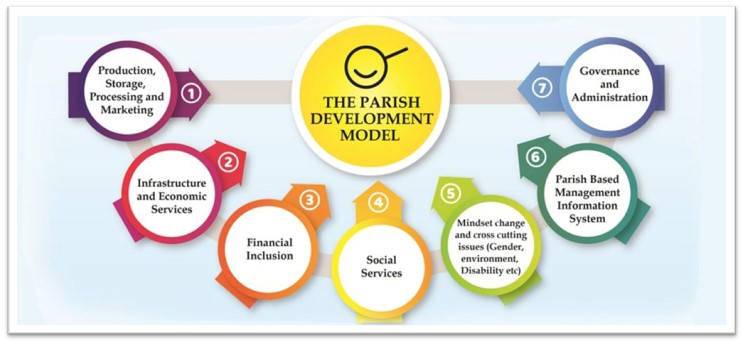
The seven pillars of PDM
Agricultural Value Chain Development — production, storage, processing, and marketing.
Infrastructure and Economic Services — the physical and economic services that enable production and marketing.
Financial Inclusion — delivery of financial services: business development, credit, insurance, savings, leasing, and payments.
Social Services — health, education, environment, and other community services.
Community Mobilisation and Mindset Change — shifting attitudes from subsistence survival to business-oriented production.
PDMIS Foundation Pillar — the database of household and community profiles used to identify and track beneficiaries.
Governance and Administration — managing, supervising, coordinating, and accounting for the programme.
The Financial Inclusion Pillar
This pillar deals with access to finance and is led by the Ministry of Finance, Planning and Economic Development. Its objective:
“To sustainably transform subsistence households into the money economy by easing access to and use of appropriate financing.”
Households should not only receive money — they should access the right financing, use it well, repay it, save, and reinvest. The pillar has six components:
Community organisation — forming groups, joining SACCOs, and working together for production and income.
Business development services and financial literacy — planning enterprises, managing money, keeping records, saving, and repaying loans.
The Parish Revolving Fund — financing delivered to beneficiaries through PDM SACCOs.
PDM systems — digital registration, disbursement, monitoring, and reporting.
Market linkages — connecting producers to buyers.
Agricultural insurance — reducing the risks of farming and production.
What is a PDM SACCO?
A PDM SACCO is a member-owned and member-controlled multipurpose cooperative at the parish level, formed to provide affordable credit and promote a savings culture. It is the main channel through which Parish Revolving Fund money is disbursed to community members, and membership is open to all households in the parish — especially the poor and vulnerable.
A PDM SACCO is more than a place to receive money. It organises members, promotes savings, provides affordable credit, guides enterprise development, supports repayment, and helps members improve their economic situation.
What is an Enterprise Group?
An enterprise group is a group whose members share common objectives and are engaged in a common income-generating activity. Under PDM the structure flows upward: households → enterprise groups → the PDM SACCO.
This arrangement makes mobilisation, training, lending, monitoring, and repayment easier, and encourages people in similar enterprises to support one another, share knowledge, and improve production.
The seven selected PDM enterprises
PDM prioritises seven enterprises for intensive agriculture, chosen because they can generate income when properly planned and managed:
Poultry
Fish farming
Piggery
Food crops (e.g. cassava, bananas, rice, Irish potatoes, sorghum, millet)
Dairy
Fruits (e.g. passion fruits, mangoes, oranges, pineapple)
Coffee (clonal coffee)
These are linked to practical household models — for example one acre of clonal coffee, one acre of food crops for the family, one acre of pasture for about eight dairy cattle, or backyard poultry, piggery, and fish farming. The overall message: households should use their land, skills, and market opportunities to choose enterprises that earn income.
Read the official PDM guidelines
What a PDM SACCO does
The SACCO works across four functional areas:
Production — coordinating quality inputs (through input credit or grants), extension services, post-harvest management and storage, member profiling and organisation, and risk mitigation such as irrigation.
Marketing — preparing members to meet market requirements, bulking, price negotiation, contract management, and primary processing.
Technical assistance — training, mentorship and coaching, advisory services, compliance to standards, mindset change, and management information systems.
Finance and investment — mobilising savings, managing loans and credit, promoting agricultural insurance and products such as micro-leasing, and providing financial literacy.
In short, a PDM SACCO should help members produce better, sell better, manage money better, and build sustainable enterprises — not simply hand out loans.
The cooperative identity of a PDM SACCO
A PDM SACCO is built on cooperative values: self-help, self-responsibility, democracy, equality and equity, solidarity, social responsibility (caring for the community), and honesty and openness. In practice this means members take ownership of their own progress, one member has one vote, everyone is treated fairly (including women, youth, and persons with disabilities), and finances are transparent.
It also follows seven cooperative principles:
Voluntary and open membership — open to all eligible parishioners without discrimination.
Democratic member control — members set policies and elect representatives; one member, one vote.
Member economic participation — members contribute to and democratically control the cooperative’s capital.
Autonomy and independence — the SACCO stays member-controlled even when partnering with government or NGOs.
Education, training, and information — continuous capacity building in financial literacy, bookkeeping, and enterprise skills.
Cooperation among cooperatives — SACCOs and groups link, pool resources, and form federations for scale.
Concern for community — working for sustainable community development and resilience.
Who can borrow PDM money?
To borrow from the Parish Revolving Fund, a person must meet all of the following:
Be a resident of the parish in Uganda.
Be a member of an enterprise group that belongs to the PDM SACCO in that parish.
Come from a subsistence household, as confirmed at community vetting meetings.
Not have already benefited from an Emyooga loan.
Commit to invest the loan in a qualifying agricultural value-chain project among the priority enterprises (poultry, fish, dairy, coffee, piggery, fruits, food crops).
Have no outstanding loan with the PDM SACCO.
In other words, PDM money is not for general consumption. It is for organised parish residents from subsistence households who are ready to invest in productive enterprises.
Not sure whether you qualify, or how to join a PDM SACCO in your area? Get in touch, and we’ll help you find the right people and take the next step:
The PDM loan process
The PDM loan process moves through the following stages:
Stage 1 — Application
A member who wishes to borrow submits a loan application form and a business plan to the chairperson of their PDM Enterprise Group. Every PDM loan is fixed at UGX 1 million and carries an interest of 6% per annum. The enterprise group leadership conducts due diligence on the applicant and, if satisfied that the application is genuine and the enterprise is viable, forwards it to the PDM SACCO chairperson for the next stage.
Stage 2 — Appraisal
The PDM SACCO Loans Committee appraises each application through a desk review and a field visit to the applicant's household. The SACCO leaders then work with the LC1 chairpersons in the parish to hold community vetting meetings, where the list of applicants cleared by the committee is confirmed to ensure each one genuinely comes from a subsistence household. For successful applicants, the loan details and business plan are entered into PDMIS by the borrower, with support from the Parish Chief or the Sub-County Community Development Officer.
Stage 3 — Loan approval
The loans captured on PDMIS are reviewed and approved on the system by the PDM SACCO Treasurer and Chairperson. The chairperson then authorises payment of the approved loans and informs the PDM Enterprise Group chairpersons of the list of applicants who have been cleared, so that members know their loans are ready for disbursement.
Stage 4 — Loan disbursement on WENDI
Disbursement is made through the WENDI mobile wallet. Working from the list of loans approved on PDMIS, the PDM SACCO Chairperson uses their mobile phone to initiate the transfer of UGX 1 million from the SACCO's WENDI account to the borrower's WENDI account. The PDM SACCO Secretary and Treasurer must then each separately approve the disbursement from their own mobile phones before the funds are released, providing a triple-authorisation control over every payment.
Stage 5 — Receiving funds
Once loan details are validated on WENDI and PDMIS, funds are transferred to the borrower’s mobile phone, and an instant SMS is sent to the borrower and all SACCO leaders. Beneficiaries are encouraged to pay for inputs and services by mobile money and only withdraw cash when unavoidable. Withdrawals are free at PostBank, Housing Finance, Pride Microfinance, bank branches, and WENDI agents. As directed by the President, a beneficiary can withdraw exactly UGX 1 million, in instalments or as a lump sum.
Stage 6 — Loan monitoring
Monitoring is led by the PDM Enterprise Group and SACCO leaders, working with the Parish Development Committee, GISO, DISO, RDCs, Operation Wealth Creation, and others. The PDM Secretariat and implementing agencies also make field visits. The aim is to ensure money is used for the intended productive investments, not diverted to consumption.
Stage 7 — Loan repayment
Every PDM loan has a grace period of 24 months. After that, it must be repaid within 12 months, in instalments or as a lump sum, into the PDM SACCO WENDI account. Once recovered, the money revolves to benefit new members — it is not a one-time giveaway.
Stage 8 — Reporting and accountability
The SACCO submits regular reports to sub-county and district authorities, and records are kept in PDMIS and WENDI for transparency, improving accountability and making the programme easier to track.
Still unsure about your loan, your SACCO, or the next step? Reach the Transform Africa team, and we’ll help point you in the right direction:
How to repay a PDM loan on WENDI
Repay digitally through WENDI by following these steps:
Dial
*229#on your phone.Select 6 for Groups.
Select 2 for Group Transactions.
Select 5 for Member to Group.
Select 2 for PDM loan repayment.
Enter the group code, the amount, and your PIN, then wait for the confirmation notification.
Make sure there is money on your WENDI account, and never share your WENDI PIN with anyone.
What is WENDI?
WENDI is a digital platform designed by PostBank and licensed by the Bank of Uganda. It is the engine that powers PDM SACCO operations, helping the government disburse, monitor, and track revolving funds at the parish level. Its main benefits are:
Access and convenience
WENDI removes the need to travel far to open accounts or withdraw funds — both leader authorisation and beneficiary access happen from a mobile phone or an agent. A person can self-onboard with a smartphone or a feature phone (“kabiriti”) using *229#. Funds can be accessed at MTN and Airtel agents, PostBank, Housing Finance Bank, Pride Microfinance, and Exim Bank branches countrywide, with other banks (Centenary, Stanbic, Finance Trust, Guaranty Trust, Opportunity) also integrated.
Transparency
WENDI gives full visibility and traceability of funds to the last-mile beneficiary. SACCO leaders get SMS alerts when a wallet is funded, and both the beneficiary and leaders are alerted when the UGX 1 million loan lands in the wallet. Detailed beneficiary reports are available in real time.
Financial inclusion
WENDI uses Uganda’s wide mobile coverage to extend services to households — supporting disbursements, payments, savings, and loan repayments at parish level. Savings in individual wallets attract interest of 10% per annum.
Lower transaction costs
By removing middlemen and travel, WENDI cuts costs — and there are no withdrawal fees charged on PDM beneficiaries.
The people who make PDM work
PDM is delivered close to the citizen through trained facilitators, training centres, and local leaders.
Community-Based Facilitators (CBFs)
A CBF is a trained person (preferably a youth) who delivers demand-driven services to beneficiaries — business development, extension services, certified inputs, production services (planting, weeding, spraying), digital services such as PDMIS and mobile wallets, post-harvest handling, and market access. Each SACCO should have at least two CBFs, profiled on PDMIS-FIS and supervised by local government at sub-county and parish levels.
Practical Training Centres (PTCs)
A PTC is established by the SACCO to provide hands-on training, extension, business development, and financial literacy within the parish. It prepares beneficiaries to access loans and invest wisely, then hand-holds them afterwards. It is hosted by a model farmer or selected site and follows the Farmer Field School approach — learning by doing.
Have a question about any part of PDM, or not sure where to start? Get in touch and we’ll point you in the right direction:
Key stakeholders and their roles
PDM SACCO leaders — manage the Parish Revolving Fund; mobilise, register and guide groups and households; ensure fair access, record keeping, recovery, and monitoring.
Resident District Commissioners (RDCs) — supervise government programmes in the district, prevent misuse or diversion of funds, and report to central government.
Parish Development Committee (PDC) — oversees all PDM activities at parish/ward level, mobilises households, and develops parish action plans, budgets, and reports.
Parish Chief / Ward Agent — coordinates PDM at parish/ward level, profiles all households on PDMIS, compiles the annual SPEAR report, and serves as secretary to the PDC.
Chief Administrative Officers / Town Clerks — accounting officers who ensure financial management, accountability, and reporting at district/urban level.
The right business mindset: Ekibalo
PDM requires a shift from subsistence living to business thinking. Because the money is for investment, not consumption, beneficiaries are encouraged to adopt these attitudes:
Profit-oriented thinking — “Am I making a profit or a loss?”
A savings culture — saving part of earnings to reinvest.
Record keeping — knowing costs, income, and debts clearly.
Customer focus — producing what the market wants.
A growth mindset — starting small but aiming to expand.
Discipline and commitment — treating the enterprise seriously.
Planning an enterprise: the Ekibalo steps
Ekibalo is the simple enterprise plan every beneficiary should prepare before borrowing:
Select an enterprise from the PDM priorities that fits your land, skills, and market.
Estimate inputs and costs — list seeds, feeds, tools, labour, rent, transport, and the cost of each.
Estimate outputs and sales — expected quantity multiplied by the selling price.
Calculate profit — sales minus costs. Positive means viable; negative means revise the plan.
Plan repayment and savings — show how the loan will be repaid and how much will be saved.
A worked example (poultry)
A simple Ekibalo for 65 birds:
Chicks: 65 × UGX 3,000 = UGX 195,000
Feeds: 5 bags × UGX 120,000 = UGX 600,000
Vaccination: UGX 50,000
Labour: UGX 150,000
Total cost: UGX 995,000. Expected sales: 65 × UGX 25,000 = UGX 1,625,000. Profit: 1,625,000 − 995,000 = UGX 630,000. Because the profit is positive, the enterprise is viable. Without Ekibalo, a beneficiary might borrow without knowing whether the enterprise can repay the loan.
PDM by the numbers (as of 3 November 2025)
10,589 PDM SACCOs registered and funded.
UGX 3.261 trillion transferred by Government to SACCO accounts.
UGX 3.219 trillion disbursed by SACCOs to last-mile beneficiaries.
3.262 million beneficiaries.
8,689 WENDI agents.
What the money has been borrowed for:
Crops — UGX 1.089 trillion (36.14%)
Livestock — UGX 1.081 trillion (35.88%)
Coffee — UGX 0.385 trillion (12.78%)
Poultry — UGX 0.366 trillion (12.16%)
Other — UGX 0.091 trillion (3.03%)
Most borrowing has gone into crops and livestock, reflecting PDM’s strong focus on agricultural production and household enterprise.
Mindset and growth
Mindset can build or break a person. A clear illustration is the story of an elephant so used to being held by a rope that it never tries to break free — even when it easily could. The lesson: many people stay trapped by old beliefs even when they have the power to change. PDM therefore needs not only money but a mindset shift — the belief that you can work, produce, save, repay, grow, and improve your household.
Success story in Kibuku District
Conclusion
The Financial Inclusion Pillar helps Ugandan households move from subsistence into the money economy by organising people at parish level, forming enterprise groups, strengthening PDM SACCOs, providing affordable credit, promoting savings, supporting training, linking to markets, and using digital systems (PDMIS and WENDI) for transparency.
It is not just about giving money. It is about choosing viable enterprises, preparing Ekibalo, investing productively, monitoring progress, repaying loans, saving, and growing — backed by a shift from dependency to business thinking. With everyone playing their part, PDM aims to create practical socio-economic transformation from the grassroots, one household and one parish at a time.
Need help with this?
Get more information or reach the office responsible for this project.